Loading...
Unseen disruption to plants, soil microbiomes, and ecosystem health by toxic agrochemicals and their sustainable management strategies
Md. Nahid Mahmud
,Md Atikur Rahman
Abstract
Uncontrolled use of toxic chemical pesticides in crop production is one of the serious concerns in Bangladesh. Most of the ordinary farmers are not aware of pesticide toxicity, optimal applicable doses, consumer health risks, and their own safety, from acute poisoning to chronic illnesses like cancer. Chemical pesticide toxicity occurs through contamination in soils, plants, food chain contamination, and overall degradation of ecosystem health. Therefore, it is crucial to address this growing hazard and its sustainable management strategies in Bangladesh. The aim of the study was to screen the present scenario of agrochemical toxicity and share opinions on their management strategies for sustainable agricultural production and ensure food safety. Advanced studies suggest that the intense use of herbicides, fungicides, insecticides, and chemical fertilizers alters soil microbiome structure and functions. These correlated changes inhibit symbiosis of effective microbes, plant growth promotion, disease resilience, nutrient uptake, and abiotic stress tolerance. Therefore, in this commentary article, it is recommended to introduce several cost-effective and eco-friendly sustainable strategies, including microbial bioremediation, bioaugmentation or biostimulation, biofertilizers, and One Health policies to mitigate disruption of plant, soil microbiomes, and ecosystem health.
INTRODUCTION
Psychoactive substances (PAS) use is a major global public health problem, contributing to global morbidity, mortality, and social disruption. According to the World Drug Report 2023, 292 million people worldwide were using illicit drugs in 2021, a 20% increase from the previous decade, with 64 million people diagnosed with substance use disorders. In Sub-Saharan Africa, the burden of PAS use rapidly increased, driven by socioeconomic vulnerabilities, urbanization, and limited access to prevention and curative services [1, 2]. PAS use is associated with increased risk behaviors, including violence and unprotected sex, and serious health outcomes, such as sexually transmitted infections, mental health problems, and chronic diseases [3-5]. The consequences extend beyond the individual and affect families and society.
Modern agriculture highly depends on insecticides, herbicides, pesticides, and synthetic fertilizers to produce yield for a growing population. In Bangladesh, agricultural crops are valuable due to multiple environmental stresses, pathogen attacks, and severe exposure to diverse chemical pesticides (CPs). Most of the CPs belong to the group of organophosphates, carbamates, pyrethroids, organochlorines, and neonicotinoids. Chlorpyrifos, dimethoate, diazinon, malathion, and quinalphos are the highest-use CPs in Bangladesh [1]. Bangladeshi farmers are highly dependent on these toxic CPs in agricultural crop production. This dependency carries a largely invisible cost for crops, soil microbiome, and overall ecosystem health.
The CP toxicity effect induces microbiome erosion, reduces their diversity, and alters functions and community composition.
Erosion of the soil microbiome alters nutrient cycling, induces disease suppression, and declines plant resilience. Uncontrolled use of CPs disturbs soil biodiversity, declines effective microbial functions, and creates long-term limitations of agricultural sustainability and food safety [2-3]. Pesticides and associated pollutants change soil physicochemical properties, reshaping microbial community composition (MCC) by stimulating tolerant taxa and repressing sensitive ones [4]. Because soil microbiomes mediate the link between CP application and downstream ecological and human-health outcomes. Therefore, it is crucial to introduce sustainable and cost-effective strategies to mitigate disruption of toxic agrochemicals in plants, soils, and the total ecosystem.
MECHANISTIC GAPS LINKING TOXICITY TO MICROBIOME DEGRADATION
Despite of growing harmful evidence, the field remains fragmented by inconsistent mechanistic understanding. Arbuscular mycorrhizal fungi (AMF), key symbionts for phosphorus (P) and water uptake, show highly variable responses to pesticides, ranging from neutral to strongly negative depending on the active substance, dose, and soil context [5]. Field-scale evidence across a three-thousand-kilometer European gradient confirmed that conventional fungicide use measurably reduces AMF phosphorus transfer efficiency (PTE) relative to non-cropped soils [6]. Legume nodulation and nitrogen(N)-fixing symbioses are similarly disrupted, with growth, nodule number, and nutrient accumulation suppressed after pesticide exposure [3], while even biologically derived pesticides can shift AMF community structure [7]. Sublethal exposures add further complexity: low-dose glyphosate (GP) either induces or inhibits Arabidopsis plant growth depending entirely on which root-associated bacterial strains are present, showing that the microbiome itself changes toxicological consequences rather than merely suffering from them [8]. These impacts extend beyond soils; GP’s inhibition of the shikimate pathway, shared by soil and gut bacteria, has been linked to shifts in the human gut microbiome, illustrating a toxicological continuum from field to human physiology [9]. Persistent, bound residues can also act as long-term reservoirs that periodically re-expose microbial communities. Bridging these gaps requires standardized, dose-resolved, multi-omics studies linking microbial functional shifts directly to plants and ecosystem outcomes.
INTEGRATIVE SOLUTIONS: A CONCEPTUAL MODEL TO PROTECT PLANT, SOIL AND ENVIRONMENT
Addressing these gaps demands a systems-level framework connecting agrochemical inputs, microbiome responses, plant health, and ecosystem-scale outcomes with feedback loops informing safer chemical design (Figure 1). Encouragingly, applied solutions are advancing. Microbial bioremediation using indigenous or introduced degrader consortia can accelerate detoxification; in a bioreactor system [10], this tool degraded 81% of the fungicide ametoctradin within 72 hours versus a two-week field half-life, correlating with enrichment of Burkholderiales degraders [11]. Bioaugmentation and biostimulation are increasingly proposed as scalable restoration tools [12], while biofertilizers offer pathways to simultaneously detoxify residues and promote plant growth. Explicit recognition of soil microbiomes within One Health policies has also been proposed to align agrochemical regulation with human, animal, and environmental outcomes [13].
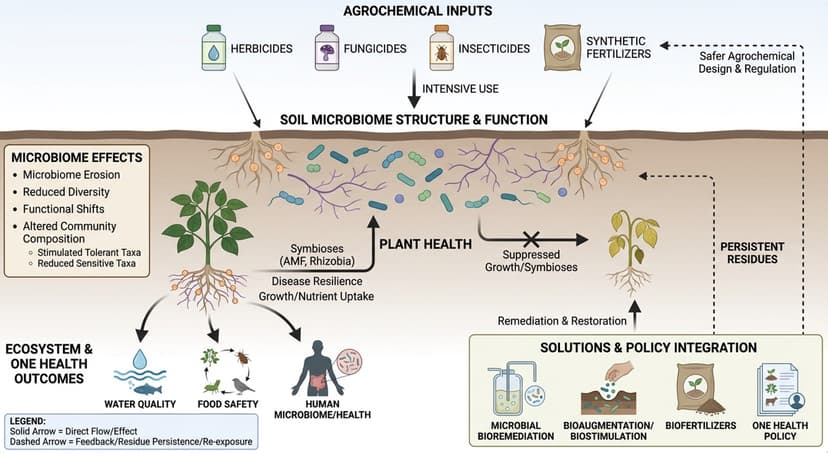
Figure 1.
Conceptual model of agrochemical toxicity and microbiome degradation. In an ecosystem with One Health outcomes, beneficial microbes, including AMF and rhizobia, are involved in symbioses, which help to enhance disease resilience, plant growth, nutrient uptake, and ultimate plant health. These healthy plants are linked to the water cycle, better ecosystems, food safety and human microbiome, and ultimate health. In contrast, toxic agrochemical inputs alter microbiome structure and function, which leads to suppressed symbiosis of effective microbes and inhibits plant growth and development. To protect plant, soil, and ecosystem health, sustainable strategies should be implemented, including microbial bioremediation, bioaugmentation/biostimulation, application of biofertilizer, and one health policy. Dashed feedback arrows indicate residue persistence/re-exposure and the way bridging research (bottom panel) should reform safer agrochemical design and regulation.
CONCLUSIONS AND FUTURE INITIATIVES
This commentary article here conforms the agrochemical toxicity and microbiome degradation are mechanistically entangled processes with consequences extending from individual soil aggregates to global food security and human health. Until now, the field remains constrained by inconsistent methodologies, short-term studies, and a persistent disconnect between toxicology, microbiology, and policy. Further work should be emphasized on standard, long-term, multi-site field traits that capture realistic dose and mixture exposures rather than single- compound laboratory assays. It should develop microbiome-based bio-indicators for routine agrochemical risk assessment. As a consequence, it should deploy bioremediation consortia and biofertilizers validation at field level, and it should emphasize integrating soil microbiome health into One Health and pesticide-registration frameworks. Only this convergence of mechanistic research, applied biotechnology, and policy reform can ensure plant, soil, and environmental health. The overall initiative and implementation of these strategies could be a safeguard against the growing pressures of chemical intensification.
ACKNOWLEDGEMENTS
None.
AUTHOR CONTRIBUTIONS
MAR designed outlines and drafted the manuscript. MNM wrote the initial draft of the manuscript. MNM reviewed the scientific content described in the manuscript. All authors have read and agreed to the published version of the manuscript.
CONFLICTS OF INTEREST
There is no conflict of interest among the authors.
DECLARATION OF USING AI-ASSISTED TOOLS
During the preparation of this manuscript, the authors used artificial intelligence (AI) tools to improve readability and language quality. Following the use of technological support, the author(s) reviewed and edited the text as required and take full responsibility for the text of the publication.
References
[1]
Khatun P, Islam A, et al., Pesticides in vegetable production in Bangladesh: A systemic review of contamination levels and associated health risks in the last decade. Toxicol Rep. 2023; 11, 199-211.
[2]
Mahmud MN, Mittra PK, et al. Uncontrolled use of chemical pesticides in vegetable crops: A growing food safety crisis in Bangladesh. Toxicant Res. 2025;1:35–43.
[3]
Abd-Alla MH, Omar SA, et al. The impact of pesticides on arbuscular mycorrhizal and nitrogen-fixing symbioses in legumes. Appl Soil Ecol. 2000;14(3):191–200.
[4]
Djukić D, Mandić L. Microorganisms and technogenic pollution of agroecosystem. Acta Agric Serb. 2000;5(10):25–46.
[5]
Hage-Ahmed K, Rosner K, et al. Arbuscular mycorrhizal fungi and their response to pesticides. Pest Manag Sci. 2019;75(3):583–590.
[6]
Edlinger A, Garland G, et al. Agricultural management and pesticide use reduce the functioning of beneficial plant symbionts. Nat Ecol Evol. 2022;6(8):1145–1154.
[7]
Ipsilantis I, Samourelis C, et al. The impact of biological pesticides on arbuscular mycorrhizal fungi. Soil Biol Biochem. 2012;45:147–155.
[8]
Ramirez-Villacis DX, Finkel OM, et al. Root microbiome modulates plant growth promotion induced by low doses of glyphosate. mSphere 2020;5(4):e00484-20.
[9]
Walsh L, Hill C, et al. Impact of glyphosate (Roundup™) on the composition and functionality of the gut microbiome. Gut Microbes 2023;15(2):2263935.
[10]
Ahmed T, Rahman MS, et al. Utilization of endophytic bacteria for liquid biofertilizer production with a newly designed prototype fermentor for plant improvement. Plant Trends 2024;2:92–107.
[11]
Whittington HD, Singh M, et al. Accelerated biodegradation of the agrochemical ametoctradin by soil-derived microbial consortia. Front Microbiol. 2020;11:1898.
[12]
Huang X, Lu G. Editorial: Bioremediation of chemical pesticides polluted soil. Front Microbiol. 2021;12:682343.
[13]
Singh BK, Yan ZZ, et al. Soil microbiomes must be explicitly included in One Health policy. Nat Microbiol. 2023;8:1367–1372.
Share and Cite
Harvard Style
Mahmud, M. and Rahman, M., 2026, 'Unseen disruption to plants, soil microbiomes, and ecosystem health by toxic agrochemicals and their sustainable management strategies', Toxicant Research, vol. 2, no. 3, pp. 69-72.
ACS Style
Mahmud, M.; Rahman, M. Unseen disruption to plants, soil microbiomes, and ecosystem health by toxic agrochemicals and their sustainable management strategies. Toxicant Research 2026, 2(3), 69-72. https://doi.org/10.66439/tr.2026.08
AMA Style
Mahmud, M.; Rahman, M. Unseen disruption to plants, soil microbiomes, and ecosystem health by toxic agrochemicals and their sustainable management strategies. Toxicant Research. 2026;2(3):69-72. https://doi.org/10.66439/tr.2026.08
Chicago/Turabian Style
Mahmud, Md. Nahid ; Rahman, Md Atikur . 2026. "Unseen disruption to plants, soil microbiomes, and ecosystem health by toxic agrochemicals and their sustainable management strategies" Toxicant Research 2, no. 3: 69-72. https://doi.org/10.66439/tr.2026.08
APA Style
Mahmud, M.; Rahman, M. (2026). Unseen disruption to plants, soil microbiomes, and ecosystem health by toxic agrochemicals and their sustainable management strategies. Toxicant Research, 2(3), 69-72. https://doi.org/10.66439/tr.2026.08
Article Metrics
Article Access Statistics
Article Info
Academic Editor
Md. Abdul Hannan, PhD
Received
10 August 2026
Accepted
18 September 2026
Published
26 September 2026
Article DOI
10.66439/tr.2026.08Corresponding Author
Md Atikur Rahman
,Institute of Biological Sciences, University of Rajshahi, Rajshahi 6205, Bangladesh
;Email: atik.rahman@ru.ac.bd
Cite this article
Mahmud M, Rahman M. Unseen disruption to plants, soil microbiomes, and ecosystem health by toxic agrochemicals and their sustainable management strategies. Toxicant Res. 2026; 2(3), 69-72. 2026; 2(3): 69-72