Loading...
Therapeutic effects of dietary supplementation with fresh Moringa oleifera leaf juice in a mouse model of combined diet- and STZ-NA-induced hyperlipidemia and type 2 diabetes
Md. Monir Hossain
,Saiful Islam
,Mir Md. Iqbal Hasan
,Saiful Islam
,Shahana Begum
,Md. Mustafijur Rahman
Abstract
Previous studies demonstrated either antidiabetic or antihyperlipidemic effects of Moringa oleifera using extracts or leaf powders in separate mouse models. However, evidence regarding the therapeutic efficacy of fresh Moringa oleifera leaf juice as a dietary supplement remains limited, particularly in a combined diet and STZ-NA (streptozotocin–nicotinamide)-induced hyperlipidemia and type 2 diabetes in a mouse model. This study focuses on the long-term dietary supplementation with fresh moringa leaf juice in patients with concurrent type 2 diabetes and hyperlipidemia. A total of eighty (80) Swiss albino mice were used, with forty (40) randomly divided into four equal groups for diabetes induction and proof of concept for hypoglycemic activity, considered as Trial 1, and the remaining 40 were divided into another four groups for combined induction of hyperlipidemia and diabetes, as Trial 2. The mouse group for both trials was named T0 (diabetic control), and the treatment groups were T1, T2, and T3, supplemented with fresh moringa leaf juice at 2, 3, and 4 mL/100 mL of drinking water, respectively, for 12 weeks. In Trial 1, blood glucose levels decreased significantly (P<0.05) to 8.46, 8.62, and 9.2 mmol/L in T1, T2, and T3, respectively, compared with the control group mice. In Trial 2 (diabetic hyperlipidemic mice), triglycerides (TG), low-density lipoprotein (LDL), cholesterol, and blood glucose decreased significantly (P<0.05) in T1, T2, and T3 compared with the control group. High-density lipoprotein (HDL) increased significantly (P<0.05) in the treatment groups compared with the control group. These findings extend current evidence by highlighting that long-term dietary supplementation with fresh Moringa leaf juice improves both hyperglycemia and dyslipidemia in a combined metabolic disease model.
INTRODUCTION
Diabetes mellitus and hyperlipidemia are increasingly recognized as important metabolic disorders affecting both humans and animals worldwide, including more frequently in Bangladesh. However, metabolic disorders, including diabetes mellitus and hyperlipidemia, have emerged as important health concerns in humans and various domestic animals [1, 2], leading to significant economic losses either through medication or production losses. Persistent hyperglycemia may cause severe complications affecting renal, cardiovascular, ocular, and nervous systems, ultimately leading to reduced productivity and increased mortality [3]. Recent studies also demonstrated that diabetes mellitus is closely associated with oxidative stress, inflammation, and dyslipidemia in both humans and animals [4], [5]. Improper dietary management and lifestyle can contribute to metabolic imbalance, occasionally resulting in sudden death or stroke-like conditions in both humans and animals due to obesity, diabetes, and dyslipidemia. The regulation of plasma cholesterol and blood glucose levels remains an important therapeutic strategy in the management of metabolic disorders [6]. Conventional management of diabetes and hypercholesterolemia primarily involves dietary regulation, physical activity, and synthetic drugs. However, prolonged use of chemical drugs may cause adverse effects and increase treatment costs, encouraging the search for safer and cost-effective herbal alternatives [7]. The World Health Organization has also recognized the importance of traditional and herbal medicine in primary healthcare systems. Among medicinal plants, Moringa oleifera has attracted significant scientific interest because of its rich nutritional and pharmacological properties. Different parts of the plant contain bioactive compounds such as flavonoids, alkaloids, tannins, saponins, glycosides, phenolics, and vitamins, which contribute to its therapeutic potential [8]. Recent experimental studies further demonstrated that moringa leaf extract improves insulin sensitivity, reduces oxidative stress, and lowers serum cholesterol and triglyceride levels in diabetic animal models [9], [10]. Fresh moringa leaf juice may retain natural water-soluble phytochemicals, heat-sensitive vitamins, antioxidant enzymes, and other bioactive compounds that may be partially lost during drying, extraction processing, and storage in extract or powder. Moreover, fresh moringa leaf juice, devoid of solvent-related processing, may provide greater nutritional integrity, making fresh leaf juice a natural dietary supplement [11], [12].
Although numerous studies have reported the antidiabetic or antihyperlipidemic effects of M. oleifera, most investigations have evaluated dried leaf powder, aqueous or organic solvent extracts, or purified phytochemical fractions under either diabetic or hyperlipidemic conditions alone [8,13,14,15]. Fresh leaf juice, intended for direct dietary consumption and potentially better preserving naturally occurring water-soluble phytochemicals, antioxidant enzymes, and heat-labile vitamins, has received comparatively little scientific attention. Furthermore, the therapeutic potential of long-term dietary supplementation with fresh M. oleifera leaf juice has not been adequately investigated in an experimental model that simultaneously mimics type 2 diabetes and hyperlipidemia. Such a combined metabolic model more closely resembles the coexistence of dyslipidemia and hyperglycemia commonly observed in clinical and veterinary practice than single-disease models.
Therefore, this study was designed to address these knowledge gaps through two sequential experiments. In Trial 1, an STZ–NA (streptozotocin–nicotinamide)-induced mouse model was used to confirm the hypoglycemic efficacy of fresh M. oleifera leaf juice. Subsequently, in Trial 2, the therapeutic efficacy of long-term dietary supplementation with fresh M. oleifera leaf juice was evaluated in a combined diet- and STZ–NA-induced mouse model of hyperlipidemia and type 2 diabetes by assessing glycemic status, lipid profile, hematological indices, and selected biochemical parameters. This study provides novel evidence regarding the efficacy of fresh M. oleifera leaf juice as a practical long-term dietary supplement in a clinically relevant combined metabolic disorder model.
MATERIALS AND METHODS
Study site
The experimental trial on an animal model was conducted at the Laboratory Animal House, Department of Physiology, Sylhet Agricultural University, Sylhet, Bangladesh.
Ethical approval for animal use
Research, educational, and testing projects are carried out with a strong commitment to animal welfare and are approved by the Institutional Animal Ethics Committee of Sylhet Agricultural University (Approval #AUP2023005).
Preparation of fresh M. oleifera leaf juice
Moringa oleifera leaves were collected from the residential area of Sylhet Agricultural University. The leaves were then separated from the stems, washed with distilled water, and air-dried until completely dry. Then the moringa leaves were blended using an electric blender, and the extract was filtered through a mesh sieve. Finally, the extract was collected in a glass bottle and prepared for mixing with drinking water at different dose levels. The prepared M. oleifera leaf juice was stored and used for treatment for one month.
Experimental animals and housing before trial
A total of eighty (80) Swiss albino mice, 28 days old, were collected from the Mice House, Department of Microbiology, Rajshahi University. Primarily, the animals were kept in cages, and proper laboratory conditions and atmosphere were provided for 24 hours a day for seven days to allow the animals to adapt. The animals were housed in stainless steel cages under standard laboratory conditions with a 12 h light/12 h dark photoperiod. Clean autoclaved wood shavings were provided as bedding material, and the animals had ad libitum access to water and a standard pellet diet. All animal care and handling procedures were conducted in accordance with the National Institutes of Health (NIH, 1985) guidelines [16].
Experimental diet
Only commercially available mouse pellet feed (Jamuna Traders, Dhaka) was supplied to the mouse group of Trial 1. However, in Trial 2, a special high-cholesterol and lipid-rich experimental feed was formulated for the dietary induction of hyperlipidemia. To prepare this diet, the commercially available pellet was ground using an electric blender (WBL-VK10N, Walton, Bangladesh), and then the necessary amount of water, 100 mL of soybean oil, 10 gm salt, and 5 g 2% cholesterol (Sigma, USA) were added to each kg of diet. After thoroughly mixing all the ingredients, we used a pellet machine to pelletize the mixture. Next, we dried the pellets overnight using a rotating table fan. Then, those semi-dried pellets were dried in moderate sunlight for 48-72 hours until they were dry to the touch and felt lightweight. This feed was supplied to the mice group in Trial 2 until the induction of hyperlipidemia. Following the development of hyperlipidemia, the commercially available mice feed was supplied to the mice group of Trial 2 until the end of the trial.
Study design and layout
A total of eighty (80) Swiss albino mice at 28-day age were selected, and an RCT (Randomized Controlled Trial) study design was applied for this study. After a week of acclimatization, eighty (80) mice were equally divided into two experimental trial groups (N=40). In Trial 1, forty (40) mice were randomly divided into four equal groups (n=10), named T0 (positive control with no treatment and the treatment groups were T1, T2, and T3. Diabetes was induced using the STZ-NA (Streptozotocin- Nicotinamide) model at a dose rate of NA 120 mg/kg + STZ 55 mg/kg intraperitoneally [17]. The induction of diabetes was confirmed using a blood glucometer after five days of intraperitoneal injection administration. Then, fresh M. oleifera leaf juice supplementation started from day-07 at the dose rate of 2, 3, and 4 ml/100ml drinking water in treatment groups T1, T2, and T3, respectively, for 12 weeks to assess the hypoglycemic activity of fresh leaf juice in induced type 2 diabetic mice. Commercial mouse feed was supplied in this trial during the experimental period.
In Trial 2, the remaining 40 mice were randomly divided into four equal groups (n=10), named T0 (positive control with no treatment), and the treatment groups were T1, T2, and T3 for concurrent development of hyperglycemia with hyperlipidemia. To induce hyperlipidemia, mice in the respective treatment groups were fed a high-cholesterol, lipid-rich diet daily for 12 weeks (3 months), which was considered sufficient for the development of hyperlipidemia [18]. After confirmation of hyperlipidemia through blood biochemistry analysis, diabetes was induced using the STZ-NA (Streptozotocin- Nicotinamide) model [17]. The induction of diabetes was confirmed using a blood glucometer after 5 days of intraperitoneal injection administration. Then, the treatment group mice T1, T2, T3 were supplemented with fresh Moringa leaf juice at 2, 3, and 4 ml/100ml drinking water with commercially available mouse feed, respectively, for 12 weeks for efficacy assessment of fresh Moringa leaf juice on concurrent type 2 diabetes, hyperlipidemia, and hematological parameters.
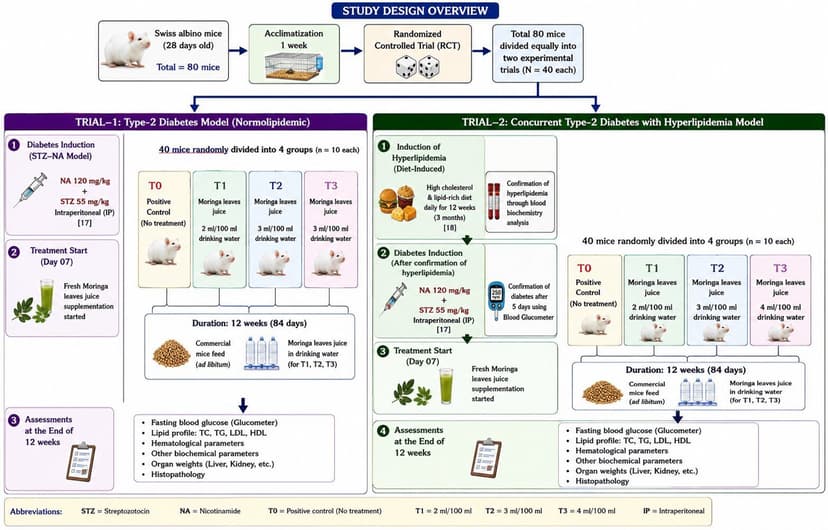
Figure 1.. Study design and layout.
Therapeutic efficacy assessment of fresh M. oleifera leaf juice on type 2 diabetes in Trial 1
Before measuring the blood glucose level, the mice were kept fasting for 12 hours each time. Blood glucose levels in fasting conditions were estimated at 14-day intervals on days 0, 14, 28, 42, 56, 70, and 84 during both experimental therapeutic treatment trials of moringa fresh leaf juice. Blood glucose levels were measured by pinching the tail vein of mice, and a drop of blood was applied to the test kit of a blood glucometer (Accu-Chek Instant S, Germany).
Therapeutic efficacy assessment of M. oleifera fresh leaf juice on concurrent type 2 diabetes and hyperlipidemia in Trial 2
Blood glucose level was measured by following the same procedure as in Trial 1 throughout the treatment period. At the end of the 3-month treatment period, mice were kept fasting for 14-16 hours before blood collection. The mice were anesthetized with a combination of ketamine (100 mg/kg) and xylazine (10 mg/kg) administered by the intraperitoneal route according to the approved institutional ethical protocol before blood collection [19]. Blood samples were collected from five (05) mice of each group by cardiac puncture and from the tail vein in K3-EDTA-coated vacuum tubes for hematological analysis and without anticoagulant for serum separation. Blood serum was collected overnight for biochemical analysis. Then, CBC (Complete Blood Count) was performed in an autoanalyzer (PROKAN, PE-7010 vet, China). The lipid profile, including triglyceride (TG), cholesterol, high-density lipoprotein (HDL), and low-density lipoprotein (LDL), was estimated using a kit and following the manufacturer's protocol in a semi-automated biochemistry analyzer (PKL PPC, Pokler Italia 115) at the Department of Physiology, SAU, Sylhet.
Statistical analysis
One-way analysis of variance (ANOVA) was done on the obtained research data using SAS analytical software. Duncan Multiple Range Test (DMRT) analysis was performed to express the difference among the treatment groups. GraphPad Prism Version 10 was used for figure creation
RESULTS
Therapeutic efficacy of moringa leaf juice dietary supplementation on type 2 diabetes in Trial 1
The fasting blood glucose levels of all experimental groups were markedly elevated on day 7 following diabetes induction, recording 19.50±1.52, 18.14±0.58, 18.54±1.28, and 18.70±0.87 mmol/L in T0, T1, T2, and T3 groups, respectively. A slight reduction in blood glucose level was observed in the treatment groups receiving moringa leaf juice by day 14 compared with the diabetic control group (T0), although the differences were not statistically significant (p>0.05).
However, from day 28 onward, a significant (p<0.05) decline in fasting blood glucose levels was observed in all treatment groups compared to the control group, and this decreasing trend continued through days 42, 56, 70, and 84.
At the end of the experiment (day 84), the fasting blood glucose level in the diabetic control group (T0) increased progressively to 23.16±1.79 mmol/L. In contrast, glucose levels significantly decreased (p<0.05) to 10.18±0.10, 9.92±0.14, and 9.50±0.18 mmol/L in T1, T2, and T3 groups, respectively (Table 1). No significant differences were observed among the treatment groups. During the latter half of the experiment, blood glucose levels in the treated groups decreased gradually and eventually remained nearly constant, suggesting the long-term glycemic control potential of moringa leaf juice.
Table 1. Effects of moringa leaf extract on blood glucose in diabetic mice in Trial 1
Therapeutic efficacy of M. oleifera leaf juice dietary supplementation on concurrent type 2 diabetes and hyperlipidemia in Trial 2
The efficacy of fresh M. oleifera leaf juice in reducing both blood glucose and cholesterol in mice with concurrent diabetes and hyperlipidemia after moringa leaf juice supplementation is shown in Table 2.
Following the induction of diabetes and hyperlipidemia, all experimental groups (T0, T1, T2, and T3) exhibited elevated levels of blood glucose and lipid profile parameters at day 90. At day 180 of the experiment, treatment with moringa leaf juice significantly (p<0.05) improved the lipid profile and reduced blood glucose levels in the treated groups (T1, T2, and T3) compared with the diabetic-hyperlipidemic control group (T0).
Figure 2 indicates the efficacy of moringa leaf juice on type 2 diabetes along with hyperlipidemia at the end of the experiment. At day 180, treatment with M. oleifera leaf extract significantly (p<0.05) improved both glycemic status and lipid profile in the treated groups (T1, T2, and T3) compared with the untreated control group (T0). TG, LDL, TC, and BG levels were significantly reduced, whereas HDL levels increased in the treated groups. The greatest improvement was observed in the T3 group, particularly for HDL, LDL, and TC levels. However, no significant variation was found among the treatment groups for blood glucose reduction.
Table 2. Efficacy of moringa leaf juice on diabetes along with hyperlipidemia in Trial 2.
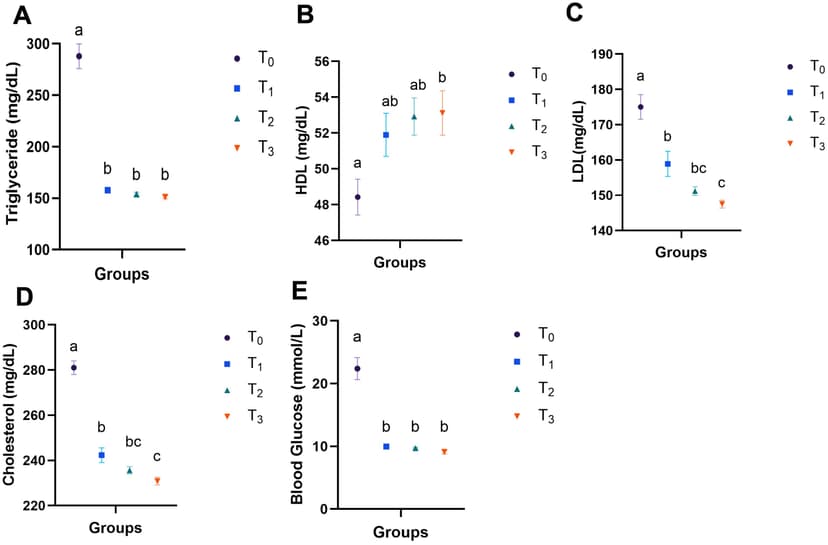
Figure 2. Effects of moringa leaf juice on serum lipid profile and plasma glucose level in Trial 2. T0 = Diabetic control; T1 = 2 mL/100 mL; T2 = 3 mL/100 mL; T3 = 4 mL/100 mL fresh Moringa oleifera leaf juice supplementation. HDL = High-Density Lipoprotein, LDL = Low-Density Lipoprotein.
Effects of M. oleifera leaf extract on Hematological parameters in Trial 2
The effect of the Moringa extract on hematological parameters in mice is presented in Table 3. The results showed that TLC and lymphocytes were considerably higher (P<0.05) in the T3 group compared to the T0 and T2 groups, but not significantly higher (P>0.05) in the T1 group. However, there was no significant difference (P>0.05) in these two metrics across the treatment groups.
Table 3. Effect of M. oleifera leaf extract on hematological parameters in diabetic hyperlipidemic mice in Trial 2.
DISCUSSION
The present findings are consistent with previous studies demonstrating the antidiabetic activity of M. oleifera in experimental animal models. The observed hypoglycemic effect may be attributed to bioactive phytochemicals, including flavonoids, polyphenols, quercetin, and chlorogenic acid, which have been reported to enhance peripheral glucose uptake, improve insulin sensitivity, and regulate key carbohydrate-metabolizing enzymes [20, 21]. In addition, the antioxidant properties of these compounds may protect pancreatic β-cells against oxidative stress-induced damage, thereby preserving insulin secretion and improving glycemic homeostasis [22]. Similar antihyperglycemic effects have been reported for aqueous M. oleifera leaf extracts in streptozotocin-induced diabetic models by Abd Eldaim et al. [23] and Leone et al. [8]. Unlike most previous studies that investigated solvent extracts or dried leaf preparations, the present study evaluated long-term dietary supplementation with fresh M. oleifera leaf juice in a combined diet- and STZ–nicotinamide-induced type 2 diabetic hyperlipidemic mouse model. Therefore, the sustained reduction in blood glucose observed over the 12-week supplementation period provides additional evidence supporting the therapeutic potential of fresh leaf juice as a practical dietary intervention for chronic metabolic disorders.
In addition to its antihyperglycemic activity, M. oleifera fresh leaf juice exhibited significant hypolipidemic effects. These beneficial effects are likely mediated by flavonoids, saponins, alkaloids, tannins, and other polyphenolic compounds. Flavonoids improve insulin signaling and glucose utilization, whereas saponins are known to reduce intestinal cholesterol absorption and promote bile acid excretion, thereby lowering circulating cholesterol concentrations [24, 8]. Furthermore, the antioxidant activity of these phytochemicals may alleviate oxidative stress and chronic inflammation associated with diabetes and hyperlipidemia, ultimately contributing to improved lipid metabolism and preservation of pancreatic β-cell function [22].
The significant reductions in serum TG, LDL, cholesterol, and blood glucose observed in the present study are consistent with previous reports describing the beneficial metabolic effects of M. oleifera in experimental diabetic models [20, 23]. High-density lipoprotein (HDL) increased significantly (p<0.05) in the treatment group compared to the control group. The concurrent improvement of both glycemic and lipid parameters suggests that fresh M. oleifera leaf juice may simultaneously target multiple metabolic abnormalities associated with type 2 diabetes and dyslipidemia. These findings further indicate that long-term dietary supplementation with fresh leaf juice could represent a safe and cost-effective nutritional strategy for improving metabolic homeostasis.
The hematological findings indicated that long-term dietary supplementation with fresh M. oleifera leaf juice had no adverse effect on erythrocytic or platelet indices, as TEC, Hb, PCV, and PLT remained comparable among all experimental groups (P > 0.05). These observations are consistent with the findings of Nurhayati et al. [25], suggesting that M. oleifera supplementation does not negatively affect normal hematopoiesis. In contrast, a significant increase in total leukocyte count, particularly lymphocyte populations, was observed, which agrees with the findings of Ghebreselassie et al. [26]. This increase may reflect the immunomodulatory potential of M. oleifera, possibly mediated through its abundant antioxidant vitamins, flavonoids, and phenolic compounds that enhance immune cell proliferation and protect leukocytes against oxidative damage. Collectively, these findings suggest that fresh M. oleifera leaf juice not only improves metabolic disturbances but may also support immune function without inducing hematological toxicity during prolonged dietary supplementation.
CONCLUSIONS
This study revealed that fresh M. oleifera leaf juice possesses significant hypoglycemic and hypolipidemic activities in experimental animals with concurrent type 2 diabetes and hyperlipidemia. Regular administration of the fresh leaf juice improved blood glucose, lipid profile, and hematological parameters, suggesting its potential as a natural therapeutic agent against coexisting hyperglycemia and dyslipidemia in animal models. However, further molecular and pharmacological studies are required to elucidate the mechanisms of action of the fresh juice.
ACKNOWLEDGEMENTS
Thanks to the Department of Physiology of SAU, Sylhet, Bangladesh, for providing Lab facilities, and Sylhet Agricultural University Research System for funding this research project. This research project is funded by the University Grants Commission (UGC) of Bangladesh through Sylhet Agricultural Research System (SAURES). Besides, Figure 1 was generated using ChatGPT.
AUTHOR CONTRIBUTIONS
MMR- Designed the study, prepared and wrote the manuscript. MMH performed the experiments; SI- Assisted in the field research and laboratory work and data assembly; MMIH- Co-supervised this research project; SB and SI- Reviewed and edited the research article; MMR- Performed the manuscript preparation and writing, supervision of the research project, data analysis, and fund hunting. All authors have read and approved the final version of the manuscript.
CONFLICTS OF INTEREST
There is no conflict of interest among the authors.
DECLARATION ON USING AI-ASSISTED TOOLS
Authors used AI tools, such as ChatGPT, to improve the language quality and readability during manuscript preparation.
References
[1]
Leske MC, Wu SY, et al. Hyperglycemia, blood pressure, and the nine-year incidence of retinopathy. Ophthalmology. 2005; 112(5):799–805.
[2]
Kumar S, Malhotra R, et al. Antidiabetic and free radical scavenging potential of Moringa oleifera leaves. Asian Journal of Experimental Biological Sciences. 2010; 1(1):55–60.
[3]
Gray AM, Abdel-Wahab YH, et al. The traditional plant treatment, Sambucus nigra (Elder), exhibits insulin-like and insulin-releasing actions in vitro. Journal of Nutrition. 2000; 130(1):15–20.
[4]
Forbes JM, Cooper ME. Mechanisms of diabetic complications. Physiological Reviews. 2019; 99(1):137–188.
[5]
Galicia-Garcia U, Benito-Vicente A, et al. Pathophysiology of type 2 diabetes mellitus. International Journal of Molecular Sciences. 2020; 21(17):6275.
[6]
John S, Thangapandian S, et al. New insights in the activation of human cholesterol esterase to design potent anti-cholesterol drugs. Molecular Diversity. 2014; 18:119–131.
[7]
Rao BK, Sudarshan PR, et al. Antidiabetic activity of Terminalia pallida fruit in alloxan-induced diabetic rats. Journal of Ethnopharmacology. 2003; 85:169–172.
[8]
Leone A, Spada A, et al. Cultivation, Genetic, Ethnopharmacology, Phytochemistry and Pharmacology of Moringa oleifera Leaves: An Overview. International Journal of Molecular Sciences. 2015;16(6):12791–12835. doi:10.3390/ijms160612791.
[9]
Abd Eldaim MA, Tousson E, et al. Ameliorative effects of Moringa oleifera against metabolic disorders induced by diabetes mellitus. Environmental Science and Pollution Research. 2020; 27(20):24891–24901.
[10]
Vergara-Jimenez M, Almatrafi MM, et al. Bioactive components in Moringa oleifera leaves protect against chronic disease. Antioxidants. 2021; 10(11):1–22.
[11]
Su X, Lu G, et al. Moringa oleifera Lam.: a comprehensive review on active components, health benefits and application. RSC Advances. 2023; 13:24353–7bn24384. doi:10.1039/D3RA03584K.
[12]
Yang M, Tao L, et al. Moringa oleifera Lam. leaves as new raw food material: A review of its nutritional composition, functional properties, and comprehensive application. Trends in Food Science & Technology.2023; 138:399–416.
[13]
Standards of Care in Diabetes. Cardiovascular Disease and Risk Management. Diabetes Care. 2025;48(Suppl. 1).
[14]
C Thambiah S, Lai LC. Diabetic dyslipidaemia. Pract Lab Med. 2021; 18 (26): e00248.
[15]
Chen GL, Xu YB, et al. Hypoglycemic and hypolipidemic effects of Moringa oleifera leaves and their functional chemical constituents. Food Chemistry. 2020;333:127478.
[16]
National Institutes of Health (NIH). Guide for the Care and Use of Laboratory Animals. NIH Publication 1985. No. 85–123.
[17]
Rais N, Ved A, et al. Model of streptozotocin-nicotinamide induced type 2 diabetes: A comparative review. Current Diabetes Reviews. 2022; 18(8).
[18]
Korou LM, Agrogiannis G, et al. Comparative antilipidemic effect of N-acetylcysteine and sesame oil administration in diet-induced hypercholesterolemic mice. Lipids in Health and Disease. 2010; 9:23.
[19]
Kim Suvarna, S. C. Layton. Bancroft’s theory and practice of histological techniques. 2019, Elsevier: Oxford, UK.
[20]
Bamagous GA, Al Ghamdi SS et al. Antidiabetic and antioxidant activity of Moringa oleifera extract in diabetic rats. Saudi Journal of Biological Sciences. 2018; 25(8):1587–1593.
[21]
Gupta R, Mathur M, et al. Evaluation of antidiabetic and antioxidant activity of Moringa oleifera in experimental diabetes. Journal of Diabetes & Metabolic Disorders. 2019; 18(2):473–482.
[22]
Xiao X, Wang J, et al. Protective effects of flavonoids from Moringa oleifera against diabetes-induced oxidative stress. Food Chemistry. 2020; 315:126256.
[23]
Abd Eldaim MA, Tousson E, et al. Antidiabetic and antioxidant effects of Moringa oleifera in streptozotocin-induced diabetic rats. Environmental Science and Pollution Research. 2021; 28(3):3024–3031.
[24]
Vergara-Jimenez M, Almatrafi MM, et al. Bioactive components in Moringa oleifera leaves protect against chronic disease. Antioxidants. 2019; 8(10):431.
[25]
Ghebreselassie D, Mekonnen Y, et al. The effects of Moringa stenopetala on blood parameters and histopathology of liver and kidney in mice. Ethiopian Journal of Health Development. 2005; 25(1):51–57.
[26]
Nurhayati T, Fathoni MI, et al. Effect of Moringa oleifera leaf powder on hematological profile of male Wistar rats. Journal of Blood Medicine. 2023; 14:477–485.
Share and Cite
Harvard Style
Hossain, M. and Islam, S. and Hasan, M. and Islam, S. and Begum, S. and Rahman, M., 2026, 'Therapeutic effects of dietary supplementation with fresh Moringa oleifera leaf juice in a mouse model of combined diet- and STZ-NA-induced hyperlipidemia and type 2 diabetes', Toxicant Research, vol. 2, no. 3, pp. 34-43.
ACS Style
Hossain, M.; Islam, S.; Hasan, M.; Islam, S.; Begum, S.; Rahman, M. Therapeutic effects of dietary supplementation with fresh Moringa oleifera leaf juice in a mouse model of combined diet- and STZ-NA-induced hyperlipidemia and type 2 diabetes. Toxicant Research 2026, 2(3), 34-43. https://doi.org/10.66439/tr.2026.05
AMA Style
Hossain, M.; Islam, S.; Hasan, M.; Islam, S.; Begum, S.; Rahman, M. Therapeutic effects of dietary supplementation with fresh Moringa oleifera leaf juice in a mouse model of combined diet- and STZ-NA-induced hyperlipidemia and type 2 diabetes. Toxicant Research. 2026;2(3):34-43. https://doi.org/10.66439/tr.2026.05
Chicago/Turabian Style
Hossain, Md. Monir ; Islam, Saiful ; Hasan, Mir Md. Iqbal ; Islam, Saiful; Begum, Shahana ; Rahman, Md. Mustafijur . 2026. "Therapeutic effects of dietary supplementation with fresh Moringa oleifera leaf juice in a mouse model of combined diet- and STZ-NA-induced hyperlipidemia and type 2 diabetes" Toxicant Research 2, no. 3: 34-43. https://doi.org/10.66439/tr.2026.05
APA Style
Hossain, M.; Islam, S.; Hasan, M.; Islam, S.; Begum, S.; Rahman, M. (2026). Therapeutic effects of dietary supplementation with fresh Moringa oleifera leaf juice in a mouse model of combined diet- and STZ-NA-induced hyperlipidemia and type 2 diabetes. Toxicant Research, 2(3), 34-43. https://doi.org/10.66439/tr.2026.05
Article Metrics
Article Access Statistics
Article Info
Academic Editor
Md. Abdul Hannan, PhD
Received
01 July 2026
Accepted
08 August 2026
Published
16 August 2026
Article DOI
10.66439/tr.2026.05Corresponding Author
Md. Mustafijur Rahman
,Department of Physiology, Faculty of Veterinary, Animal and Biomedical Sciences, Sylhet Agricultural University, Sylhet-3100, Bangladesh
;Email: mustafij.dph@sau.ac.bd
Cite this article
Hossain M, Islam S, Hasan M, Islam S, Begum S, Rahman M. Therapeutic effects of dietary supplementation with fresh Moringa oleifera leaf juice in a mouse model of combined diet- and STZ-NA-induced hyperlipidemia and type 2 diabetes. Toxicant Res. 2026; 2(3), 34-43. 2026; 2(3): 34-43