Loading...
Old vehicle-emitted air pollution in Dhaka: A major driver of respiratory diseases
Akhi Moni†
,Md. Abdul Hannan
,Md Jamal Uddin†
Abstract
Dhaka, the capital of Bangladesh, is experiencing a public health emergency due to high air pollution, with emissions of nitrogen dioxide, particulate matter, carbon monoxide, and hydrocarbons from old vehicles. These old vehicles are playing a central role in the deterioration of air quality, and they ultimately cause severe respiratory diseases like asthma, chronic obstructive pulmonary disease, and irritation in all individuals, but especially children and transport workers. Due to old vehicle emissions, the city suffers from excessive levels of harmful pollutants, which surpass WHO and national standards. Thus, immediate steps should be taken to reduce the emissions from old vehicles to protect the population of Dhaka.
INTRODUCTION
The persistent air pollution in Dhaka, Bangladesh, primarily arising from vehicular emissions of nitrogen dioxide (NO2), particulate matter (PM), carbon monoxide, and hydrocarbons, poses a significant public health crisis, significantly contributing to the prevalence of various respiratory diseases [1]. This alarming situation is exacerbated by rapid urbanization, inadequate infrastructure, and a high concentration of older, less-regulated vehicles, leading to consistently elevated levels of particulate matter [1]. These fine particulate matter pollutants (PM2.5 and PM10) are specifically linked to widespread respiratory diseases, cardiovascular complications, and elevated mortality rates within the population [2]. Specifically, approximately 85% of air pollution in Dhaka originates from brick kilns, surface dust, and vehicle emissions, with artificial sources broadly contributing more [3]. Therefore, this study aimed to report that old vehicle-emitted air pollution in Dhaka is the potential cause of respiratory disease.
SCALE AND SOURCES OF AIR POLLUTION
Dhaka consistently ranks among the world’s most polluted cities, with PM2.5 and PM10 levels far exceeding national and WHO guidelines [1, 3-9]. The number of vehicles is increasing very quickly, a lot of which are old, refurbished, and not properly maintained. This has caused an uneven rise in emissions of carbon monoxide, nitrogen oxides, particulate matter, and other harmful pollutants [1, 4, 5, 10-12]. Diesel-powered buses, trucks, and two-stroke engine vehicles are particularly significant contributors, emitting high levels of black smoke and toxic gases [1, 4, 5, 11].
AIR POLLUTION ON RESPIRATORY DISEASES
There are severe impacts of vehicle-emitted pollutants on health. Particularly, among vulnerable groups such as children, the elderly, and outdoor workers, exposure to vehicle-emitted pollutants is strongly linked to increased rates of respiratory diseases, including asthma, chronic bronchitis, reduced lung function, and pneumonia [3, 7, 8, 10, 12-15]. According to studies, prolonged exposure to vehicular air pollution in Dhaka is directly linked to alarmingly high rates of respiratory symptoms and impaired lung function in the traffic police and other high-exposure groups [10, 12-14]. Children are particularly at high risk, with elevated PM2.5 levels correlating with increased incidence of pneumonia and other respiratory diseases [8, 15]. The number of deaths in Bangladesh is increasing with increasing air pollution due to chronic respiratory diseases, according to GBD data of 2023 (Figure 1).
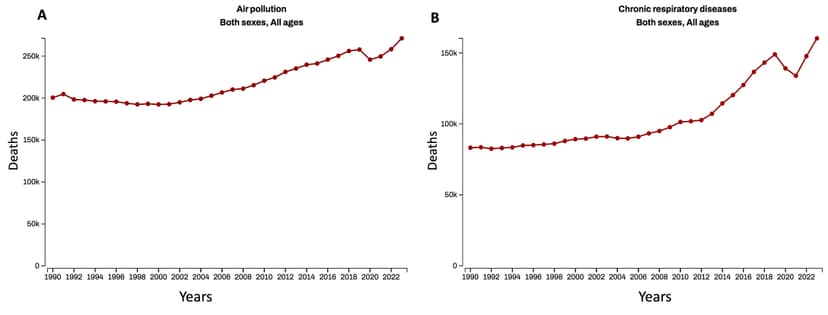
Figure 1. The number of deaths in Bangladesh is increasing with A) air pollution and B) chronic respiratory diseases in both sexes and all ages, according to Global Burden of Disease (GBD) 2023 data.
SOCIOECONOMIC AND POLICY DIMENSIONS
The economic burden of transportation-related air pollution is significant, encompassing healthcare costs, lost productivity, and a lower standard of living [[4]]. Some regulatory progress has been made in the fight against pollution, such as banning leaded gasoline and two-stroke engines. But the enforcement remains inconsistent, and the growing vehicle fleet threatens to outpace these gains [[1], [4], [5]].
URGENT NEED FOR ACTION
A multi-pronged approach is required to mitigate this crisis of old vehicle-emitted air pollution in Dhaka. The approach includes making emission standards stricter, getting old cars off the road, encouraging the use of cleaner fuels and public transport, and adding more green spaces [1, 3, 5, 11]. To protect residents of Dhaka from the escalating health risks posed by vehicular air pollution, public awareness campaigns, frequent health monitoring for high-risk populations, and effective urban planning are crucial.
CONCLUSIONS
Without proper action to reduce emissions from older vehicles, Dhaka’s air pollution will continue to promote a growing epidemic of respiratory diseases, undermining public health and economic development (Table 1). The evidence is clear that cleaner transport and stronger regulation are urgent imperatives to hinder a growing epidemic of respiratory diseases in Dhaka.
Table 1. Key findings on vehicle-emitted air pollution and respiratory health in Dhaka
ACKNOWLEDGEMENTS
None.
AUTHOR CONTRIBUTIONS
MJU and AM: Writing and original draft preparation; MAH and MJU: Writing-review and editing. All authors have read and agreed to the published version of the manuscript.
CONFLICTS OF INTEREST
There is no conflict of interest among the authors.
DECLARATION ON USING AI-ASSISTED TOOLS
During the preparation of this manuscript, the authors used artificial intelligence (AI) tools (such as Consensus and Quillbot) to improve readability and language quality. The author(s) reviewed and edited the text as required and take full responsibility for the text of the publication.
References
[1]
Ahmed F, Bayazid AZM, et al. The terrible air pollution in dhaka city is getting worse. GSC Advanced Research and Reviews. 2024, 19(01), 042–052.
[2]
Islam S, Tarik I, et al. Air pollution and health hazards: A narrative review from the bangladesh perspective. Bangabandhu Sheikh Mujib Medical College Journal. 2024;3:101-6.
[3]
Dibya TB, Proma AY, et al. Poor respiratory health is a consequence of dhaka’s polluted air: A bangladeshi perspective. Environ Health Insights. 2023;17: 11786302231206126.
[4]
Khuda K. Air pollution in the capital city of bangladesh: Its causes and impacts on human health. 2020;6:737-50.
[5]
Kudrat EK. Causes of air pollution in bangladesh’s capital city and its impacts on public health. Nature Environment and Pollution Technology. 2020;19:1483-90.
[6]
Moniruzzaman M, Shaikh MAA, et al. Seasonal changes and respiratory deposition flux of pm2.5 and pm10 bound metals in dhaka, bangladesh. Chemosphere. 2022:136794.
[7]
Rahman M, Nahar K, et al. Respiratory emergency department visits associations with exposures to pm2.5 mass, constituents, and sources in dhaka, bangladesh air pollution. Annals of the American Thoracic Society. 2021(1): 28-38.
[8]
Sherris A, Begum B, et al. Associations between ambient fine particulate matter and child respiratory infection: The role of particulate matter source composition in dhaka, bangladesh. Environ Pollut. 2021;290:118073.
[9]
Siddiqui SA, Jakaria M, et al. Chronic air pollution and health burden in dhaka city. European Respiratory Journal. 2020;56(2): 2000689
[10]
Hashem RB, Siddique AB, et al. Assessment of knowledge, attitudes, and practices regarding air pollution among traffic polices in dhaka city, bangladesh: A cross-sectional study. BMC Public Health. 2024;24: 3593.
[11]
Iqbal A, Afroze S, et al. Vehicular pm emissions and urban public health sustainability: A probabilistic analysis for dhaka city. Sustainability. 2020;12:6284.
[12]
Mullick AR. Traffic air pollution and respiratory health: A cross-sectional study among traffic police in dhaka city (bangladesh). journal of medical science and clinical research. 2021;09(5): 93-97.
[13]
Ahmed S, Akter Q, et al. Effect of air pollution on fvc, fev1 and fev1/fvc% of the traffic policemen in dhaka ci. Journal of Bangladesh Society of Physiologist. 2016;11:39-42.
[14]
Basher AK, Afrin S, et al. Lung function capacity among traffic police in dhaka city. Asian Journal of Research in Infectious Diseases. 2023 14 (2):76–84..
[15]
Su J, Aslebagh S, et al. Impacts from air pollution on respiratory disease outcomes: A meta-analysis. Front Public Health. 2024;12:1417450
Share and Cite
Harvard Style
Moni, A. and Hannan, M. and Uddin, M., 2025, 'Old vehicle-emitted air pollution in Dhaka: A major driver of respiratory diseases', Toxicant Research, vol. 1, no. 1, pp. 01-04.
ACS Style
Moni, A.; Hannan, M.; Uddin, M. Old vehicle-emitted air pollution in Dhaka: A major driver of respiratory diseases. Toxicant Research 2025, 1(1), 01-04. https://doi.org/10.5454/tr.2025.01
AMA Style
Moni, A.; Hannan, M.; Uddin, M. Old vehicle-emitted air pollution in Dhaka: A major driver of respiratory diseases. Toxicant Research. 2025;1(1):01-04. https://doi.org/10.5454/tr.2025.01
Chicago/Turabian Style
Moni, Akhi ; Hannan, Md. Abdul; Uddin, Md Jamal. 2025. "Old vehicle-emitted air pollution in Dhaka: A major driver of respiratory diseases" Toxicant Research 1, no. 1: 01-04. https://doi.org/10.5454/tr.2025.01
APA Style
Moni, A.; Hannan, M.; Uddin, M. (2025). Old vehicle-emitted air pollution in Dhaka: A major driver of respiratory diseases. Toxicant Research, 1(1), 01-04. https://doi.org/10.5454/tr.2025.01
Article Metrics
Article Access Statistics
Article Info
Academic Editor
Md Atikur Rahman, PhD
Received
29 September 2025
Accepted
13 November 2025
Published
19 November 2025
Article DOI
10.5454/tr.2025.01Corresponding Author
Md Jamal Uddin
,ABEx Bio-Research Center, East Azampur, Dhaka-1230, Bangladesh
;Email: hasan800920@gmail.com
Cite this article
Moni A, Hannan M, Uddin M. Old vehicle-emitted air pollution in Dhaka: A major driver of respiratory diseases. Toxicant Res. 2025; 1(1), 01-04. 2025; 1(1): 01-04